
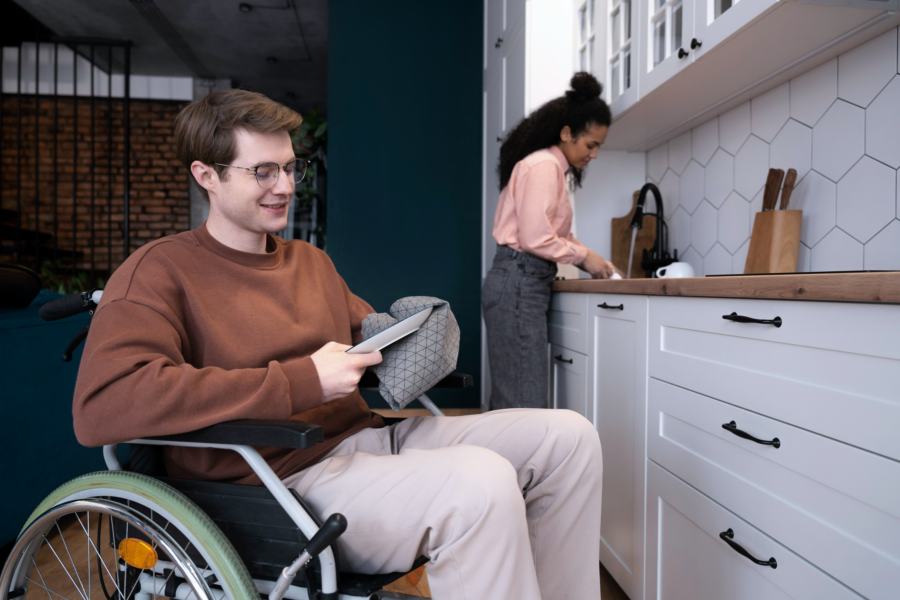
In the world of disability support, it’s easy to focus on the tangible. We measure success by tasks completed, appointments attended, and schedules met. A support worker arrives, helps with a shower, prepares a meal, and leaves. The checklist is complete. But what if this transactional approach, while efficient, misses the very heart of what it means to live well? What if the way support is given is just as important, if not more so, than the support itself?
At Lanara, we believe that true well-being is a delicate interplay between physical health and emotional vitality. It’s about feeling seen, heard, and respected. It’s about nurturing a sense of purpose and independence. This is the philosophy that underpins our unique approach to care – an approach that goes beyond the basics to embrace a psychologically-informed model of support.
This isn’t just a different way of talking about care; it’s a fundamentally different way of delivering it. It’s the difference between a support worker who sees a task to be done and one who sees a person with a rich inner world, with aspirations, fears, and a deep-seated need for connection and dignity. It’s the difference between a service that maintains and one that empowers. As a family-owned provider in Sydney, with a team of psychology-trained support workers, we have seen firsthand the profound impact that this holistic approach can have on an individual’s independence and overall well-being. This guide is for those who are seeking more than just basic care. It’s for those who believe, as we do, that everyone deserves to live a life that is not just supported, but also enriched, empowered, and full of possibility.
At Lanara, we deliver a range of NDIS support, including personal care (assistance with daily living tasks like showering, dressing, and meal preparation) and psychosocial support (capacity building for mental health, community participation, and social connection). While these are distinct services funded under different NDIS categories, what sets us apart is our commitment to bringing a psychologically-informed, person-centered approach to everything we do. For our psychosocial support services, we employ support workers with degrees in psychology or related disciplines, ensuring a deep understanding of mental health and recovery-oriented practice. Across all our services, we prioritise dignity, respect, and the understanding that how support is delivered profoundly impacts a person’s sense of self and their journey toward independence. Whether we’re supporting you with your morning routine or helping you build the confidence to engage with your community, our philosophy remains the same: genuine care, thoughtfully delivered, and uniquely yours.
What Makes Psychologically-Informed Support Different?
On the surface, task-based care and psychologically-informed support might look similar. In both scenarios, a support worker might assist with personal care or household tasks. The difference lies not in the “what,” but in the “how” and the “why.” It’s a shift in perspective from a model of “doing for” to a model of “doing with.”
Task-based care is, by its nature, transactional. The primary goal is the efficient completion of a list of duties. The support worker is seen as the expert, and the participant as the recipient of the service. While this can be effective for getting things done, it can inadvertently create a dynamic of dependency. The participant’s role can become passive, and their sense of agency can be diminished over time. Communication is often directive and focused on the task at hand.
Psychologically-informed support, on the other hand, is relational. The primary goal is to build the participant’s capacity, independence, and overall well-being. The support worker is a facilitator, a coach, and a partner. They understand that every interaction is an opportunity to build trust, foster skills, and enhance self-esteem. This approach is rooted in an understanding of human psychology – the need for autonomy, competence, and relatedness.
At Lanara, our psychosocial support workers bring formal training in psychology, skilled in active listening, motivational interviewing, and creating a strengths-based environment. Across all our services, we cultivate this same relational mindset. Our workers don’t just see a person who needs help with a task; they see a person with inherent strengths and the potential for growth.
To make this distinction clearer, let’s compare the two approaches side-by-side:
| Feature | Basic Task-Based Care | Lanara’s Psychologically-Informed Support |
| Primary Goal | Complete tasks efficiently | Build capacity and well-being |
| Participant’s Role | Passive recipient | Active partner |
| Support Worker’s Role | Expert who “does for” | Coach who “does with” |
| Communication | Directive, task-focused | Collaborative, person-centered |
| Focus | Physical tasks | Holistic (physical, emotional, social) |
| Outcome | Tasks are done | Skills are built, independence grows |
This is not to say that task-based care is inherently bad. There are times when efficiency is important. However, when it is the only model of support, it misses the vast potential for growth and empowerment that lies within every individual. A psychologically-informed approach recognizes that the small, everyday moments are the building blocks of a confident and independent life.
The Unseen Connection: Dignity, Independence, and Mental Health
Dignity is one of the most fundamental human needs, yet it is often one of the first casualties of a disability or a mental health challenge that requires reliance on others for personal care. The experience of needing help with the most intimate aspects of life—showering, dressing, personal hygiene – can be profoundly disempowering. It can chip away at a person’s sense of self, leading to feelings of shame, frustration, and helplessness. This is where the “how” of care becomes paramount.
The way personal care is delivered has a direct and powerful impact on an individual’s mental health. When a support worker rushes through a task, communicates in a clinical or impersonal manner, or makes decisions without consulting the participant, it reinforces a sense of powerlessness. It sends a subtle but damaging message: “You are a task to be completed. Your preferences don’t matter.” Over time, this can exacerbate feelings of depression and anxiety, and can become a significant barrier to building independence.
Conversely, when personal care is delivered with dignity, respect, and a genuine regard for the individual’s autonomy, it becomes a therapeutic and empowering experience. A support worker who takes the time to ask, “How would you like to do this?” or “What would make you feel most comfortable?” is doing more than just being polite. They are actively handing back a measure of control. They are affirming the person’s worth and their right to make choices about their own body and their own life.
This is the heart of the unseen connection. Dignified support fosters a sense of safety and trust, which are the essential preconditions for positive mental health. When a person feels safe and respected, they are more likely to feel confident in themselves. They are more willing to try new things, to take small risks, and to push the boundaries of their comfort zone. This is how independence is built – not through grand gestures, but through a thousand small, dignity-affirming interactions.
At Lanara, our support workers understand this deeply. Those delivering psychosocial support bring formal qualifications in psychology, equipped with specialised knowledge in mental health, trauma, and recovery-oriented practice. Across all our services, we emphasise a psychologically-informed approach – one that sees beyond the physical task to the emotional needs of the individual. Our team understands that a morning routine is not just about getting washed and dressed; it’s an opportunity to start the day with a sense of calm, control, and self-respect. They know that a conversation during meal preparation is not just small talk; it’s a chance to build rapport, to listen for signs of emotional distress, and to offer gentle encouragement. By integrating these principles into the fabric of everyday support, we transform care from a potentially disempowering experience into a powerful catalyst for improved mental health and greater independence.
More Than Just Tasks: Real-Life Examples of Integrated Support
To truly understand the difference a psychologically-informed approach makes, it’s helpful to move from the theoretical to the practical. Let’s explore a few common scenarios and contrast the task-based approach with the integrated, holistic approach that we champion at Lanara.
Scenario 1: The Morning Routine
- The Participant: Sarah is a young woman with a physical disability and social anxiety. She finds mornings overwhelming and often struggles with the motivation to get out of bed.
- The Task-Based Approach: A support worker arrives at 8 am with a checklist: assist with showering, dressing, and breakfast. The support worker is efficient, completing all tasks by 8:45 am. They might say, “Come on, Sarah, we need to get you moving,” or “Let’s get this done so you can start your day.” Sarah is clean, dressed, and fed, but she feels like a passive object in her own routine. The morning has been a stressful rush, and her anxiety levels are high.
- The Psychologically-Informed Approach (The Lanara Way): Our support worker, who is trained in psychology, understands that Sarah’s morning struggle is not about laziness, but about anxiety. They arrive with a calm and gentle demeanor. They start by checking in with Sarah: “How are you feeling this morning, Sarah? What’s one thing we could do to make the start of the day feel a little easier?” They might put on some calming music that Sarah enjoys. Instead of rushing, they break the routine into small, manageable steps, offering choices along the way: “Would you like to wear the blue shirt or the green one today?” During breakfast, they engage Sarah in a conversation about a topic she’s interested in, helping to shift her focus away from her anxiety. By the end of the routine, Sarah is not only ready for the day, but she feels calmer, more in control, and has started her day with a positive social interaction. She has been an active participant in her own morning, not a passive recipient of care.
Scenario 2: The Community Outing
- The Participant: David is a man with a psychosocial disability who wants to reconnect with his community but feels overwhelmed in social situations.
- The Task-Based Approach: The support worker’s goal is to take David to the local library. They drive him there, walk him inside, and wait while he browses. The outing is technically a success – David went to the library. However, David felt anxious the whole time, didn’t speak to anyone, and felt a sense of failure for not being more social. The experience reinforces his belief that he is “bad” at socialising.
- The Psychologically-Informed Approach (The Lanara Way): Our support worker knows that the goal is not just to get to the library, but to make it a positive and capacity-building experience. Before they go, they work with David to set a small, achievable goal for the outing. Perhaps the goal is simply to ask the librarian a question. They might practice the conversation beforehand. On the way, they talk about strategies for managing anxiety if it arises. At the library, the support worker provides quiet encouragement, and celebrates with David when he achieves his small goal. They focus on the process, not just the outcome. David leaves the library feeling a sense of accomplishment. He has had a successful social experience, which helps to build his confidence and makes him more likely to try again in the future.
In both scenarios, the tasks completed were similar. The difference was in the approach. The psychologically-informed approach transformed a routine task into a therapeutic opportunity. It built skills, fostered confidence, and enhanced well-being. This is the power of integrated support. It’s care that sees the whole person, and it’s the standard we are committed to at Lanara.
Choosing a Provider with a Holistic Approach: A Checklist for Sydney Families
When you are searching for an NDIS provider in Sydney, you are not just hiring a service; you are inviting someone into your life, your home, and your personal space. It’s a decision that deserves careful consideration. If you believe, as we do, that a holistic, psychologically-informed approach is essential for true well-being, then it’s important to know what to look for and what to ask. Here is a practical checklist to guide you in your search for a provider that truly goes beyond basic care.
The Vetting Process: What to Look For
- Read Their Website Carefully:
- Do they talk about more than just tasks? Look for words like “well-being,” “independence,” “empowerment,” “dignity,” and “person-centered.”
- Do they have an “About Us” section that explains their philosophy and values? Does it resonate with you?
- Do they highlight the qualifications and training of their staff? A provider who is proud of their team’s expertise will showcase it.
- Look for Social Proof:
- Are there testimonials from other participants or families? Do these testimonials speak to the quality of the relationship and the impact on well-being, or do they just mention reliability and punctuality?
- Do they have a presence on social media? What kind of content do they share? Is it focused on people and stories, or is it purely promotional?
The Interview: Key Questions to Ask
When you speak with a potential provider, these questions can help you uncover their true approach to care:
- “Can you describe your ideal support worker? What qualities do you look for when you hire?”
- Listen for: Words like “empathy,” “patience,” “compassion,” “good listener,” and “respectful.” A focus on character and interpersonal skills is a good sign.
- “What kind of training do your support workers receive, beyond the mandatory minimums?”
- Listen for: Mention of training in mental health first aid, trauma-informed care, person-centered support, or specific psychological approaches. At Lanara, we would tell you about our requirements for psychology or similar degrees.
- “My loved one struggles with [mention a specific challenge, e.g., anxiety, motivation, social interaction]. Can you give me an example of how your support worker would approach this?”
- Listen for: An answer that focuses on collaboration, skill-building, and emotional support, rather than just managing the problem. Compare their answer to the scenarios we described earlier.
- “How do you ensure consistency of care and build a trusting relationship between the participant and the support worker?”
- Listen for: A clear commitment to providing a consistent support worker wherever possible. A provider who understands the importance of relationships will have a plan for this.
- “How do you involve the participant and their family in the care planning process?”
- Listen for: A genuine commitment to co-design and partnership. They should see you as the expert in your own life.
A Quick Checklist for Your Decision
| Question | Yes/No |
| Did they listen more than they talked? | |
| Did they ask thoughtful questions about your needs and goals? | |
| Did you feel respected and heard? | |
| Did they speak about their participants with warmth and respect? | |
| Do you feel confident that they see the person, not just the disability? |
Choosing the right provider is a deeply personal decision. Use this checklist as a guide, but also trust your intuition. The right provider will not only tick all the boxes, but will also leave you with a feeling of confidence, hope, and genuine partnership.
The Lanara Commitment: Integrating Mind and Body for a Fuller Life
At Lanara, we are driven by a simple yet powerful conviction: that the highest standard of care is one that seamlessly integrates the needs of the mind and the body. We believe that a person’s well-being is not a collection of separate parts, but a deeply interconnected whole. You cannot nurture independence without building confidence. You cannot foster dignity without respecting emotional needs. This is the essence of our commitment to you.
Our psychologically-informed approach is not an add-on or a luxury; it is the very foundation of our service. It is woven into every interaction, every routine, and every support plan. It is the thoughtful question asked during a morning routine, the patient encouragement during a community outing, and the celebratory high-five after a small goal is achieved. It is the understanding that our role is not merely to assist, but to empower.
We are proud to be a family-owned provider in Sydney, and we bring the values of family – trust, respect, and unwavering support – to our work every day. Our team of psychology-trained support workers are not just skilled professionals; they are compassionate individuals who are genuinely invested in the well-being of the people they support. They are the heart of the Lanara Difference.
If you are ready to move beyond basic care and experience a level of support that nurtures the whole person, we invite you to connect with us. Whether you are just starting your NDIS journey, or are looking for a provider that better aligns with your values, we are here to help. Contact us today for a confidential, no-obligation conversation. Let us show you how our commitment to integrating mind and body can help you or your loved one live a richer, more independent, and more fulfilling life.
Frequently Asked Questions (FAQ)
Q: Is psychologically-informed support more expensive than standard support?
A: No. The NDIS sets price limits for different support services, and providers cannot charge more than these limits. At Lanara, our services are billed in line with the standard NDIS rates. The difference is not in the price, but in the quality and the approach. You get the benefit of our team’s higher qualifications and our holistic philosophy at no extra cost.
Q: Can I use my NDIS funding for this type of support?
A: Yes. Psychologically-informed support fits perfectly within the NDIS framework. At Lanara, we predominantly charge under two specific NDIS line items: “Assistance with Daily Living” (within Core Supports) and “Access Community Social and Rec Activ – Standard” (also within Core Supports). These line items cover the practical support we provide, whether that’s assistance with personal care, household tasks, or support to participate in community and social activities. During your planning meeting, it’s important to have goals related to your well-being, independence, and community participation, as this will ensure you have adequate funding allocated to these categories in your plan to access this type of holistic support.
Q: How do you measure the success of a psychologically-informed approach?
A: We measure success not just by tasks completed, but by outcomes achieved. We work with you to set meaningful, person-centered goals, and we track your progress towards them. Success might look like a reduction in anxiety, an increase in community participation, the development of a new life skill, or simply a greater sense of confidence and self-esteem. We regularly review these goals with you to ensure our support is making a real and positive difference in your life.
Q: Is this approach suitable for all types of disabilities?
A: We believe that a respectful, person-centered, and psychologically-informed approach is beneficial for everyone, regardless of their disability. The principles of dignity, autonomy, and building on strengths are universal. Our support is always tailored to the unique needs and goals of the individual, so whether the challenges are physical, cognitive, or psychosocial, our approach is flexible and adaptable enough to provide meaningful and effective support.