

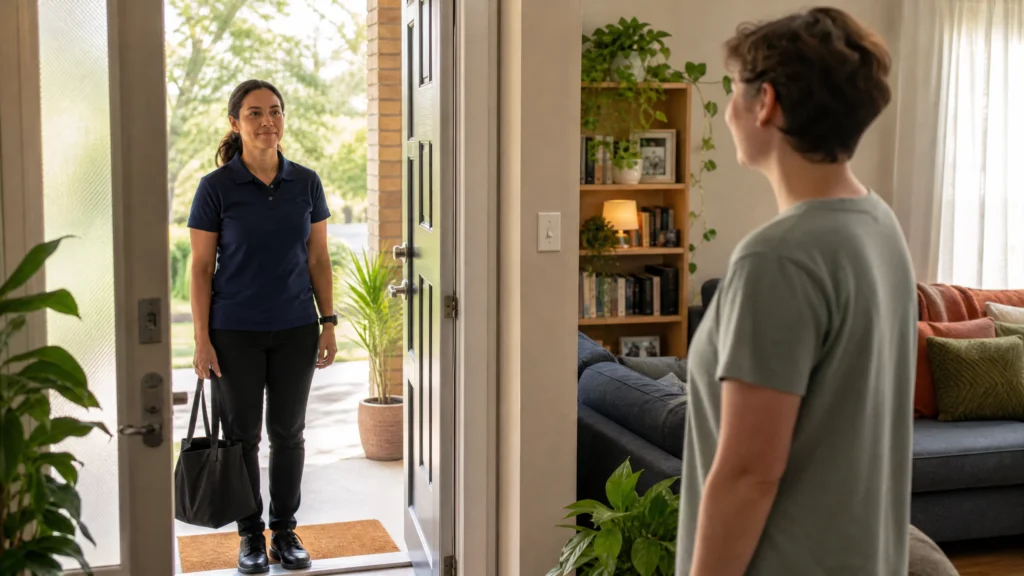
Deciding to use NDIS support is a big step. You have your plan and your goals, and you are ready to choose a provider. Then a new worry arrives: someone you have never met is going to come into your home. What will they be like? Will they respect your privacy? Will you get along? What if you feel uncomfortable?
If you feel this way, you are not alone. It is one of the most common worries new NDIS participants have. Your home is where you should feel safe and in control, and sharing it with someone new can feel like an intrusion. The worry is often stronger for people who have had bad experiences with services before, or who live with anxiety, PTSD, or autism.
This article is for anyone who is nervous about starting with a support worker. It covers the fears people most often have, what a good first visit looks like, how Lanara builds trust, the boundaries you are entitled to set, and what to do if a support worker is not the right fit.
“It’s Normal to Feel Nervous”: Validating Your Feelings
Feeling anxious about having a support worker in your home is normal. It does not mean you are not ready. It is a natural response to a new and very personal situation. These are some of the fears we hear most often from new participants:
- Fear of being judged: “What will they think of my home, my habits, or my family?”
- Fear of losing control: “Will they try to take over and tell me what to do?”
- Fear of a personality clash: “What if I just don’t like them?”
- Fear of a lack of privacy: “Will I ever feel like I have my own space again?”
- Fear of inconsistency: “What if I get a different person every week and have to start all over again?”
All of these are reasonable. The rest of this article explains what a good provider does about each of them.
What to Expect on the First Day: A Gentle Start
The first visit should be about getting to know each other, not about getting through a list of tasks. At Lanara, we treat the first few shifts as a getting-to-know-you period. This is what you should expect from any provider that puts you first:
- A Relaxed Introduction: Your Support Coordinator or a family member can be there if you want. The focus is on talking, not on filling in forms.
- Listening, Not Directing: A good support worker spends most of the first visit listening. They ask about your interests, preferences, routines, and what matters to you. You are the expert in your own life.
- Discussing Boundaries: This is the time to say things like “I prefer to have the mornings to myself” or “This room is private.” A respectful provider will welcome it.
- Starting Small: Your support worker should not walk in and start rearranging your kitchen. Start with small tasks you have agreed on, or none at all on the first day.
If your first visit with a provider feels rushed, impersonal, or all about tasks, that tells you something about how they work.
How We Build Trust: The Lanara Approach
Trust is earned over time through reliable, respectful support. These are the four things we focus on with every participant:
1. Consistency of Support Worker: Seeing the same person each time is one of the biggest things that reduces anxiety. We aim for one main support worker for you, so you do not have to keep telling your story to someone new and can build a steady working relationship with someone who knows you.
2. A Careful Matching Process: We do not just send whoever is available. We look at your support needs, your personality, your interests, and how you like to communicate. You can also tell us if you would prefer a support worker of a particular gender or age, or someone with particular experience or interests. We are happy to accommodate this. Finding the right person can take a little longer when there are several preferences to match, and we will keep you updated. We then send you the support worker’s profile, and nothing goes ahead until you have agreed to the match.
3. A Trauma-Informed Approach: Our team is trained in trauma-informed care. Many people have had experiences that make trust hard, so we work around safety, choice, collaboration, and empowerment. We move at your pace and respect your boundaries.
4. Clear Communication: You will always know who is coming to your home and when. If something changes, we tell you as soon as we can. We want your feedback, and you can raise a concern without worrying about the consequences.
Setting Boundaries: Your Right to Privacy and Personal Space
It is your home, and you are in charge. A good support worker knows this, and a good provider will back you when you set boundaries.
It is okay to say:
- “I would prefer you not to enter this room.”
- “I need some quiet time to myself between 2 pm and 3 pm.”
- “I would prefer to manage my own finances, but I might ask for help with the budgeting.”
- “Thank you for the suggestion, but I would like to do it this way.”
A support worker is there to support you, not to control you. If you ever feel your boundaries are not being respected, tell your provider. At Lanara, we treat this seriously and will act on it.
What If It’s Not Working? Your Right to Speak Up
One of the biggest worries people have is: “What if I don’t like my support worker, but I feel too guilty or scared to say anything?”
You have every right to speak up if something is not working. That is not being difficult or ungrateful. Choice and control are core principles of the NDIS, and the NDIS Code of Conduct requires providers and workers to respect your right to make your own decisions. A good provider will ask for your feedback, not just put up with it.
At Lanara, you can raise a concern in whichever way feels easiest. You can talk to your support worker directly, talk to our management team, or ask a family member or your Support Coordinator to raise it for you. We will listen, take it seriously, and work with you on a solution. You can also raise a concern at any time with the NDIS Quality and Safeguards Commission.
Sometimes a short conversation fixes things. Your support worker may not have realised that something they do makes you uncomfortable. Other times, the answer is a different support worker. That is not a failure. It means the match was not right, and we will find someone who suits you better.
You should never feel stuck with support that is not working for you.
The Role of Family in the Transition
For many participants, family is a big part of the change, especially for people who live with family or rely on them for day-to-day support. A new support worker changes things for the whole household, not just the participant.
Family members often have mixed feelings. There can be relief at sharing the load, along with worry about a stranger in the family home. Some feel guilty about handing over care, or wonder whether the support worker will do things the way they would. If this sounds familiar, our guide for families and caregivers of NDIS participants may help.
We welcome family at the first meetings and keep everyone in the loop, with the participant’s agreement. Trust needs to be built with the whole family, not just the participant.
Over time, many families find that a support worker does not replace their role. When some of the practical care is shared, family members often have more energy for simply being a parent, sibling, or partner again.
Frequently Asked Questions
Q: What if I change my mind and don’t want a support worker anymore?
A: That is your choice. You can end the arrangement at any time, in line with your service agreement. It is worth talking to your provider first, as there may be ways to change the support so it suits you better.
Q: Will my support worker judge me or my home?
A: They should not. A professional support worker is there to help, not to judge, and meets you where you are. Every Lanara support worker holds a university degree in psychology or a related discipline and has completed mental health and trauma-informed training. If you ever feel judged, tell us.
Q: Can I have the same support worker every time?
A: That is what we aim for. Consistency is one of our priorities, and we plan for you to have the same main support worker for your shifts. Occasionally a backup worker may be needed, for example if your regular worker is unwell, and we will let you know in advance whenever we can.
Q: What if I have had a bad experience with a support worker from another provider?
A: One bad experience does not mean every provider works the same way. Look for a provider whose approach suits you. We are happy to talk through what happened before and explain how we would do things differently.
The Power of a Good Match
When the match is right, early nerves usually give way to a steady working relationship. A good support worker becomes someone you can rely on: they respect your independence, understand how you communicate, back your goals, and notice your progress.
Composite example from our work. Details are combined and changed to protect people’s privacy.
One person was worried that a support worker might judge their home, rush them, or take over tasks they preferred to do themselves. What helped was the meet-and-greet, where they could talk through their routines, preferences and boundaries before regular support began. Starting with short visits also gave them time to build trust at their own pace.
Another person felt anxious about having a different worker each week and repeating personal information. We prioritise matching each participant with a consistent support worker for their regular shifts, so trust and familiarity can grow. Their anxiety eased once they had the same worker each week: someone who communicated clearly, arrived when expected, understood their routine and checked in before making any changes.
The right support should feel respectful and collaborative, not like someone taking control of your space.
Taking the First Step: It Gets Easier
The first step is often the hardest, and the anxiety you feel now is real. For most people it fades gradually, visit by visit, as trust builds. There may be some awkward moments early on. With the right provider and the right support worker, they become less frequent, and your home starts to feel like yours again.
Your Journey Starts with a Conversation
When you talk to potential providers, ask them how they build trust. Ask how they match support workers, how they handle complaints, and what happens if a match does not work. Their answers will tell you a lot about how they work.
We are happy to answer all of those questions. Contact us for a confidential, no-obligation chat about what support could look like for you. We support adults across six areas of Sydney, from the Inner West to the Eastern Suburbs.