

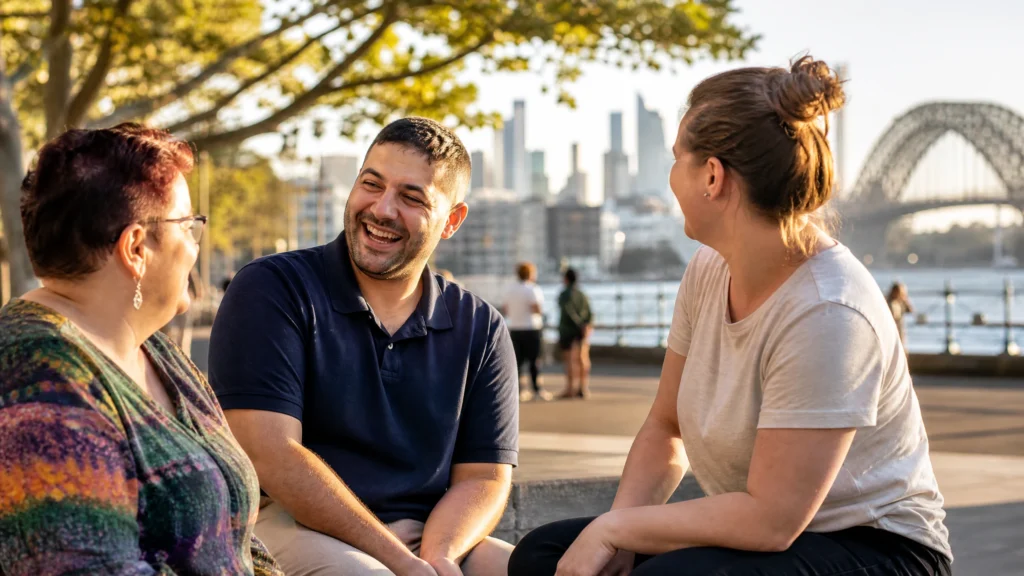
Social participation support is help to get out into your community and take part in things you enjoy, with a support worker alongside you at a pace that suits you. That might be a walk to the park, a class, a sports club or volunteering. Over time, the aim is for you to feel confident doing more on your own.
For people living with a psychosocial disability, a physical disability or a mental health condition, joining in can feel overwhelming, even when the wish to connect is strong. This guide explains what social participation support at Lanara looks like, who it can help, how it is funded and how to get started in Sydney.
Understanding the Impact of Social Isolation
Social isolation is more than feeling lonely. It can affect your mood, energy, routines and sense of purpose. For people with psychosocial disabilities, such as severe depression, anxiety disorders or schizophrenia, it can become a cycle. Symptoms make it hard to be around people, so you pull back. Pulling back can make you feel worse, and the next outing feels even harder. Breaking that cycle is rarely as simple as “just getting out more”. It usually takes patient support, one small step at a time.
What Is Social Participation Support?
Social participation support helps you get to, and take part in, activities in your community. It is built around your goals and interests, so it looks different for everyone. The aim is connection and independence: over time, relying less on paid support and more on friendships and activities in your everyday life.
The Scope of Social Participation
Support starts wherever you are now. For some people, the first step is simply leaving the house: a short walk to a local park, a coffee at a quiet café, or a trip to the library.
For others, it means a hobby group, a community class, a sports team or volunteering. Your support worker can help with introductions and be there if things feel like too much. Support also covers planning, such as working out a public transport route or practising what to say before you go.
The Lanara Difference: A Psychology-Informed Approach
Lanara’s support is psychology-informed. Every one of our support workers holds a university degree in psychology or a related discipline and has completed mental health and trauma-informed training.
Understanding the ‘Why’ Behind the Behaviour
If you feel anxious about an outing, being told to “just try” rarely helps. Our support workers try to understand what is behind the hesitation. Are you worried about being judged? Is the place too loud or crowded? Is it a low day?
Once you both know what is getting in the way, you can change the plan together: go at a quieter time, keep the visit short, agree on a way to leave early, or use coping strategies your treating team has suggested. Support work is not therapy, but a worker who understands mental health can help you put those strategies into practice.
Building Capacity, Not Dependency
We don’t want to be a permanent fixture in your social life. We want to help you do more yourself. For example, at first your support worker might do the talking at a café. Next time, you might order your own coffee. Later, you might chat with the barista, and one day go on your own. Your worker steps back a little at a time, as you feel ready.
Who Can Benefit from Social Participation Support?
Our main focus is psychosocial support, and social participation support can also suit people with physical disabilities, acquired brain injuries or neurodivergent conditions such as autism.
Individuals with Psychosocial Disabilities
If you live with depression, anxiety or bipolar disorder, activities you care about can be an important part of recovery. They can support your mood and wellbeing, build self-esteem and give your week some purpose. Because these conditions can come and go, we aim to keep support flexible, doing more on harder days and less on better ones.
Individuals with Neurodivergent Conditions
For autistic people, social situations can be confusing or tiring. A support worker can help make sense of unwritten social rules, plan for noise and crowds, and find groups that match your interests and the way you like to communicate.
Individuals Transitioning to Independence
It can also help young adults moving towards independence, or anyone going through a big change, such as moving to a new area or recovering from a serious illness. Your support worker can help you find your way around new places and start building a new social circle.
How the Process Works at Lanara
We know reaching out for support can feel daunting, especially with social anxiety. So we keep getting started gentle and clear.
Step 1: The Initial Conversation
We start with a no-obligation conversation, by phone or video call, whichever is easier for you. We learn about you and your goals, and you can ask questions and decide whether Lanara feels right.
Step 2: Comprehensive Discovery
If you go ahead, we get to know your interests, what you find hard, what has helped before, and your NDIS goals. We want to know how you like to be supported, not just what you want to do.
Step 3: Matching and Briefing
We look for a support worker who suits you, thinking about personality and shared interests as well as your needs, and we brief them before your first session. Once the initial paperwork is done, we can arrange a meet-and-greet so you can see whether you feel comfortable. We aim for you to have a regular support worker.
Step 4: Gradual Engagement
We don’t rush. The first few sessions might just be your support worker visiting you at home so you can get to know each other. Then you start with small outings and build up as your confidence grows.
Step 5: Ongoing Review and Adaptation
Your goals will change, and your support should change with them. We check in with you about how things are going. With your consent, we also keep in touch with your family and your support coordinator, and we agree with you how and how often you would like updates.
Real-World Examples of Social Participation Support
These three examples are illustrations. The names and details are invented, but the situations are typical of the support people ask for.
Example 1: Overcoming Agoraphobia to Pursue a Hobby
David lives with agoraphobia and panic attacks and has rarely left home for years. He loves photography and would like to join a local camera club, but the idea feels impossible.
Rushing him to the club could make things worse, so his support worker starts small. At first they might sit together on his front step while David practises the calming strategies his treating team has suggested. Next might be a short walk down the street, heading home if it gets too much.
Over months, they build up to a quiet park, then the camera club itself, staying ten minutes at first and then longer, until David feels ready to go on his own.
Example 2: Navigating Complex Social Dynamics
Sarah has a psychosocial disability. She finds strong emotions hard to manage and sometimes misreads social cues. She wants to make friends and join a community choir, but in the past, misunderstandings in groups have led to conflict and she has dropped out.
Before the first rehearsal, Sarah and her support worker practise common moments, like introducing herself or politely ending a conversation. During rehearsal, the worker stays in the background. If Sarah starts to feel overwhelmed or seems to have misread something, the worker can quietly suggest a break or help her check what someone meant. Afterwards, they talk about what went well and what to try next time.
Example 3: Reconnecting After a Period of Acute Illness
Mark is in his fifties and has recently come home from a long hospital stay for severe depression. He has lost touch with old friends. He would like to volunteer at a community garden but doesn’t have the energy or confidence to start.
His support worker helps with the practical side: the volunteer application, the public transport route, and spacing out his week so he doesn’t get worn out. Just as important, the worker listens when Mark feels nervous, encourages him and notices the small wins. They go to the garden together for the first few weeks. As Mark settles in and gets to know the other volunteers, the worker steps back.
Funding Social Participation Support
We support self-managed and plan-managed NDIS participants, as well as private clients. We cannot accept NDIA-managed (agency-managed) funding.
In an NDIS plan, social participation support is usually paid for from one of two support budgets:
- Core supports: the category “Assistance with social and community participation”, for help to take part in community, social and recreational activities. Core funding is flexible.
- Capacity building supports: the category “Increased social and community participation”, for building skills to find and join activities and connect with people in your area. This funding is “stated”, so it can’t be moved to other categories.
What you can use depends on your plan. If you are not sure, we are happy to talk it through with you or your support coordinator.
Taking the First Step Towards Connection
Moving from isolation to connection takes time, and you don’t have to do it alone. Lanara is a family-owned provider, and we believe everyone deserves to feel connected, valued and included. We work across many parts of Sydney: see our service areas.
When you are ready, contact Lanara for a no-obligation conversation. Call 1300 152 627 (1300-1-LANARA) or email info@lanara.com.au. We aim to respond within one business day.
Lanara is not a crisis service. If you or someone else is at immediate risk, call 000.